Late March, I decided to enroll for the Youth Hostel Association of India's Sar Pass (Himachal Pradesh) 2011 trek. I did consider their Saurkundi trek, but there seemed to be a consensus that Sar Pass is more beautiful and more difficult. Though many of my friends showed initial interest, they eventually dropped out of the plan. Only a friend- Juhi and I were left. By the time we enrolled, all batches till 19th of May were full. So I enrolled for the 21st. The batch was SP_21. Reporting venue was a village called Kasol. After checking for train routes, and asking queries on Indiamike forum, we realized that the optimum route was as follows:
Pune-Nizamuddin: Goa Express
Nizamuddin-New Delhi (ISBT Kashmere Gate): Bus
ISBT Kashmere Gate-Bhuntar: Direct bus to Manali; get down at Bhuntar
Bhuntar to Kasol: local Bus
However, inspite of booking the train tickets more than 45 days before the travel day, our status, at the time of chart preparation, was W/L 5,6! Finally had to book by Tatkal. I have never found New Delhi very hospitable to strangers. At least not the way Mumbai is. People actually just stare at you or grunt and walk away without answering even simplest of your queries. Anyways, at ISBT, we came across an old man who advised us to go to Chandigarh and from there, board a bus to Manali. He was so convincing in stating that we made a mistake by wanting to take a direct bus, that we decided to follow his suggestion. There, changing a well made plan at the last moment is always risky! Once at Chandigarh, we got down at Sector 17, then had to rush to Sector 43 from where buses to Manali leave. It was already 9pm. Now we had no option but to board whichever bus came first. The one that came had only two seats vacant and those too were next to the driver. The bus had come from Dehra Dun and was packed. There was absolutely no room for luggage and hence we had to keep our luggage with ourselves and sleep on them. After spending a very uncomfortable, sleepless night, we reached Bhuntar at around 5.15am. From there Kasol was 1 hour bus ride away.
 |
| River along the Base camp |
On reaching Kasol, the bus dropped us at YHAI Base camp, which was right next to the rapids of Parwati river. The location of the camp is simply beautiful. You can't ignore the constant rushing sound of the river. The receptionist greeted us with a big smile. We were asked to fill a movement chart, an identity card and submit our medical certificate form. People, please fill the form provided by YHAI alone, else you will be asked to go to a doctor some 9kms away and get the form filled, as 3-4 of our batch mates had to do. YHAI doesn't accept any other medical certificate but theirs. By 7.30am, breakfast was ready. Food was very simple and bland, but good considering the expenses and the camp population. Every batch consists of around 50 trekkers and at the basecamp, there are atleast 4 batches at any given time. Don't forget to bring along our own plate and bowls. Washing the plates is not a good experience as the water used for washing is the one pumped from the adjoining river and is full of suspended particles. Its color is all muddy. Plus, the water is chilling and one tries to get done with washing utensils ASAP. As washing powder gets over soon, try cleaning with soil or use a tissue paper instead to clean off the oil stains. One member was smart and had plastic sheets on the plate. Thus the plate didn't get dirty and all she had to do was throw away the sheet in the dustbin.
 |
| During the acclimatization walk |
There is nothing to do on the first day except report and rest. I was accomodated in a tent full of SP_20 trekkers. Aparantly, SP_21 members came very late and a few came the next day. So if you are pressed on time (such as getting leave and all), then you can skip the first day. The only events (apart from morning exercises and other routine events like camp fire) for the second day are a 3 hour acclimatization walk in the nearby woods and an orientation session. The walk is enjoyable and refreshing. You walk mostly beneath the trees and henc even if it is sunny outside, you feel the pleasent cool wind. We were issued a backpack, two blankets and a sleeping sheet before the walk and we were made to carry this and a litre water bottle for the walk. There is a chance that you might feel awefully tired during this walk alone and have immediate doubts about completing the actual trek. If this happens, just rubbish these thoughts out of your head. Don't overthink. That should be your mantra for the trek. Orientation session was informative. A lot of suggestions, warnings were given- regarding behaviour, clothes to wear, things to take for the trek etc. Be open to all suggestions.
I've come to realize that it is impossible to know what is the right gear to carry unless you actually carry it. So unless you have trekked in the himalaya before and are set regarding gears, better carry a little more. We were told that rain sheets, which can be bought in the base camp or in the Kasol market for Rs.40-100/- are enough to protect you from the rains. There are people who have successfully used them and who vouch for them. But my rainsheet got torn in the first 10 minutes from the market! We bought rain jacket and rain pants for INR 250/-, all the while cursing why I din't bring my jacket from Pune! One advantage of wearing a long raincoat or jacket-pant pair is your hands are free to move. Though same is true with the rainsheet, in heavy winds and rains, you need to actually hold it onto you. Also, later on in the trek, you are supposed to slide on the snow for about 2kms. A rain pants is extremely useful for this as it prevents your pants (and thermal, if you are wearing one) from getting wet. My advice- get your own sturdy raincoat from home and buy the rainsheet from the base camp for 50/- in order to cover your bag. While going to sleep, ensure that your shoes are inside the tent else, they will get wet due to due! Buy a candle from the Kasol market and rub it on the outside of the shoes to make them waterproof. Bring a pair of woolen socks or buy them from the market for around 100/-. Wearing them during night keeps feet warm. Shoes form the single most important item. I had got Quechua Forclaz 500 Ventiv following suggestions from Indiamike forum members (there is a long thread there on alpine trekking shoes, do visit it). My friend wore Forclaz 100 Lady and found it comfortable enough. Indeed, though everybody recommends a Forclaz 500, if on budget, do consider Forclaz 100. If you become a member of decathlon.in, you can get it for INR 700 instead of INR 2000. As a decathlon member, my shoes had cost me INR 2500 instead of INR 3500. Of course hunter shoes from Bata and other local manufacturers are also recommended, but I don't find them comfortable to use. In case you go without a good trekking shoes, you can buy hunter for about INR 250 at the Base Camp or in the market.
 |
| Base camp at before dawn |
The third day involved a rock climbing session. The rockface was 25feet tall, all natural (quartzite with fractures) We were made to climb using these cracks/fractures. It was considerably difficult for a number of reasons. First, it was not an ideal rockface for first timers, which majority of our batchmates were. The cracks were too small and too wide apart and for people below 5.5”, where in majority of the ladies fell, getting a grip was next to impossible. Secondly the shoes which we all were wearing were high cut, hardcore trekking shoes. It was downright stupid of YHAI trainers to expect someone to do rockclimbing in these! As my shoe was a number larger than my feet, my toe was about an inch smaller than the shoe, making it almost useless to get any grip. Also, after a point, there was simple no notch in the rock and we were expected to simply leave all grip and leap upward and try getting hold of the rockface top! Of course there was a rope and ultimately the trainers had to help almost each one of us. I got severe cramps due to rock climbing as I had to use all my strength. (I do endurance training but not weight training!) My advice, don't try too hard during rock climbing, it is somewhat pointless and might jeopardize fitness for the trek! But do try sincerely and follow all the instructions given by the trainers, they are very useful. Another activity was rapelling. It was a piece of cake for almost all of my batch. Remaining of the day went in planning the gear for the trek. It was our last chance of buying things from the market.
 |
| A Pashmini lamb while on the way to Grahan |
We left for the trek on the fourth day. It our first destination was a village called Grahan. I was down with fever, cold, severe headache and body cramps. The initial walk through the woods was very pleasent. However, after a few hours, once we came out on the open patch, we were hit by the glaring sun. It was downright hot and going got very tough. Almost all of my batchmates rate Grahan trek as the most difficult one of all. (Note: There is no need to carry more than a litre of water. The route is almost always along the stream/ river and one can refill the bottle anytime. Make sure to add a drop of chlorine to the water. ) We heard that a member of the previous batch suffered from acute dihearrea, so much so that he was shitting blood! Of course he had to go back. On our way to Grahan, we met Meenakshi, a young porter from Grahan. I was taken aback to hear that many trekkers hire porters during the trek. Initially I thought it betrayed the very concept of trekking. But then I considered that it is obviously justified for someone who wishes to travel, rather than trek through the Sar Pass. About 5 members of our batch hired Meenakshi's services. Along with her was her sister in law- Reena who shared the baggage with her. Grahan village comes before the YHAI camp. Many of the localites offer hot water bath and charging point for cellphone/ camera batteries. We couldn't do both because we were very late. However if you keep a fast pace initially, you will not only be able to have bath and get your batteries charged, but also avoid the sun for good. During our trek to Grahan, we saw Lammergier, the majestic bird whom I had seen in Yamunotri during the Great Himalayan Bird Count 2009. I was to see it again during the Padri and Ratapani trek routes. Himalayan Griffons were also frequently seen.
 |
| Grahan campsite after sunset |
Once at Grahan, I was literally fuming with fever. Batchmates helped me with an array of pills. I had sponge bath at a nearby stream and then had hot maggi at a canteen (actually a small hut) beside our tents. Felt much better. I had taken along my D80, 18-135mm lens, extra battery and a tripod. The evening light was good and I got a few nice exposures. Tried doing star photography at night, but batchmates unknowingly ruined my shots with their torches. I was still feeling weak. Also, night photography consumes a lot of battery and I was unsure as to how fast the batteries will drain and exactly how much photography opportunities will arise throughout the trek. So I decided to rest and continue with night photography during later nights. The camp leader provided with two blankets and a comfy sleeping bag. I had a sound sleep.
 |
A stream on the way to Padri.
This is my attempt at a realistic looking HDR |
Next day I felt much better. My brain was able to grasp things as normal. Our next destination was Padri. There is no village at site and the camp is located in wilderness. The trek is 100% forest trek so was very comfortable. The descend from Grahan to a lower altitude is very steep and the soil is all organic-humus and soggy. But we didn't encounter any leeches (I like getting bit by them!). As all expected the route to be a very exhaustive one like that on the previous day, we were pleasently surprised to reach padri within no time! The camp site is beautiful and we get awesome view of snow clad peaks and that of Nagaru- our later camp point. It did rain, and because of that, the night was very cold. Apart from the camp food, I had maggi at the canteen and got the warmth from the chulha. Others had omlets at the same. During orientation session, we were told that our body requires a lot more calories while trekking and hence we were all adviced to eat more. However, I found that I felt much better by eating less! I used to have only one roti, half a cup dalhia, only a few spoonful of rice and dal. And of course maggi at the lunch point. I had no problems whatsoever and I think this diet actually helped me a lot throughout. I had fantastic sleep at night and was very fresh the next morning.
 |
| Camp site, Padri |
Ratapani was our next camp site and the route was relatively quite long. I carried a friend's bag for considerable time. However I was feeling quite well and was breathing right and didn't feel tired at all. At Ratapani, we were given awesome Delhi style Chola Bhatura for breakfast, thank to our Delhieite Camp leader Mr. Gupta.
 |
| Mist and Peaks, while on the way to Nagaru |
 |
| During Ratapani- Nagaru trek |
On the route to Nagaru, out next camp site, we spotted jungle rats- beautiful hare/rat like animals who feed on the available vegetation. I later googled them to find that they are Indian Pika.The trek to Nagaru was magical. We were amidst clouds and the the breeze was cool and pleasent. I also came across the first ever snow on the way! I'll never forget that moment. I was just frantically grabbing as much snow as I could, having no definite plans regarding what to do with it! I didn't wish to part with it. But then someone pointed that I'll get plenty of snow in Nagaru, only then did I continue with my trek.
Nagaru camp was at a serious elevation. It was amidst snow. The terrain gradient was steep. Tents were all inclined and people were sliding on to eachother while sleeping. We went to bed quite early- at around 7.30pm. We woke up at 2.30am and left for Sar Pass by 4. Reason being, snow starts melting as the day proceeds and in that condition, snow becomes scarily slippery. Hence we had to avoid this by crossing Sar Pass at the earliest.
|
|
A panorama of sunset at Nagaru camp
|
 |
| The start of the Sar Pass trek. 4am! |
Thankfully the weather was pleasant and the sky was clear. By the time we reached a mid point, the dawn was breaking and I could see the mountain peaks, which rose above the clouds, glitter in the Sun's golden glory. A magnificent view! Soon enough, the actual snow trek began. We had two sherpas and a localite- Khem Thakur to help us. Sherapas used to dig their feet in the snow and make a step-like way for us. We had to step exactly in their step. The problem was their feet were just too small for most of us and we could barely fill our toes in their entire footsteps. Still it was manageable.
 |
Peaks being kissed by the first of the sun rays
|
 |
| Sherpa is busy texting his girlfriend at 5am! |
|
|
As I was busy taking pictures, I would almost always fall
behind and sometimes my fellow batchmates used to
look no larger than tiny specs
|
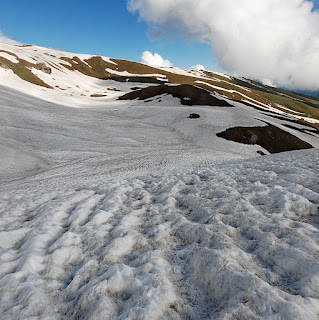 |
| A snowscape |
 |
'Sar' from Sar Pass actually means a lake. We did see a few frozen lakes like the one in the above panorama
|
Everybody was carrying walking sticks for additional support. Being left-handed, I was holding my stick towards the valley side and my body was inclined towards it rather than being against it. While the Sherpas asked me to hold the stick in my right hand, I didn't really have any problem holding it left-handed. Quite a few members slipped towards valley, but they used to slide a few feet and then stop. Then the Sherpas used to skate towards them and bring them along. Just at the end of the Sar Pass, right before biskeri top, there is a steep climb. A few members had difficulty in climbing this.
 |
| Snow forms a beautiful photography subject. An abstract snowscape |
 |
| Mist and summits |
 |
| Crossing of Sar Pass; towards Biskeri top |
 |
| Another snowscape |
 |
| The last, steep climb before Biskeri top |
 |
| Yet another one |
 |
| Khem Thakur |
Once on top, the descend began. The terrain was so steep that one has no option but to slide down for 2-3 kms! Yes its a one big long slide on snow with your bag. Don't forget to unfast the waist and chest belt of your bag.
 |
| Me with Meenakshi Di |
And then zooom! I enjoyed the slide a lot. As I was wearing rain pants which offered very little friction as opposed to the jeans which most people were wearing, I slided at breathtaking speed. I had the option of slowing down by thursting my feet in snow but I didn't. Before I knew, it was over as I reached gentler slope. I got up quickly as to avoid being collided by the next person down the slide. I didn't feel like removing my camera. I missed quite a few good shots. Though I enjoyed it, sliding was actually quite dangerous. A lot of snow had melted in previous days and many rocks were being exposed. A few batchmates banged against the rocks. With so little precaution, I though it was downright stupid of YHAI to ask people to slide in such conditions. It is just a matter of time before some incident happens. And it did, the very next day, as I later came to know. A bit on that later. My rain pants had gotten torn and my clothes got wet. Once the sliding was over, we reached lunchpoint. Maggi prices, which increased by 5/- at every camp, reached a whooping 45/- at this point. Of course people didn't complain.
 |
| While going to Biskeri |
 |
| Englacial drainage |
|
|
A stream crossing; on the way to Bhandak Thatch
|
 |
| Bhandak Thatch: 'mini Switzerland' |
The Biskeri camp was again at a very good location. But it was nothing as compared to Bhandak thatch camp. It is called 'mini Switzerland'! And aptly so. Its beauty is breathtaking. Unfortunately we didn't get clear blue sky but even in the overcast conditions, I could create some interesting images. All throughout the trek, I was regularly having a drink prepared by Meenakshi. It had nothing but pepper, ginger, salt and sugat, but it tasted wonderful. It kept my throat and stomach all okay.
 |
| A 360* panorama of Camp site, Bhandak Thatch |
 |
| Camp site, Bhandak Thatch |
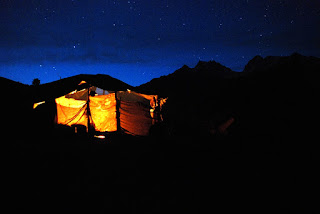 |
| Attempt at night photography, Bhandak Tatch. The illuminated tent belonged to the cook |
 |
| Another one |
 |
| A small waterfall on the way to Barsheni |
The following day, we descended to a village called Barsheni from where you get a bus to kasol. YHAI pays for the bus as long as you give them printed tickets. On the way we had to walk through a dusty site where a dam is being constructed. The sudden urban construction noise after days of recluse was a little unnerving to me. But that is how things go.
We got down at Manikaran which is 5km before kasol (from Bersheni) and a long bath in one of the hot water springs found over there. There is a maginficient Gurudwara over there and having a good hot lunch at the lunger is heavenly! Later we were invited by Meenakshi to her house at Kasol. She made some good black tea.
At Kasol, we booked tickets for our return bus to New Delhi from Bhuntar. At Bhuntar, we met Aniket from SP_22. He had suffered from a shoulder dislocation during the snow slide. His batch was very unlucky it seems. They got rains at all wrong moments and got snow fall during actual crossing of Sar Pass. They had to hold their tent from flying off during a midnight storm at Nagaru. Aniket was hit the most. He wasn't given any instructions whatsoever by the sherpas before sliding. He slided with his bag's chest belt, waist belt on and his stick dangling over his shoulders (Khem Thankur hadn't let us slide along with the stick- he was being careful and there I had thought he might be intersted in reselling the sticks to the upcoming batches! I felt very guilty for thinking so). Worst was what happened later. YHAI were totally clueless as to what to do with him. The camp leader offered to apply relisprey on a shoulder dislocation! It was here that all the loop holes were exposed. YHAI asked him to climb down – they said no doctor will climb up. Aniket had to climb down in pain till the lunch point and a little after that. There, two guides from Nepal came who carried him by turns. They reached the base camp at 2am!! His elder brother Aniruddh was with him all through. People were demanding exhorbitant money for their help. All except Khem Thakur who was one person who actually helped them. He refused 500/- which Aniruddh had offered to him (and which is equivalent of a portar's gain for carrying two person's luggage for a day), saying he helped them out of humanity. From the Base camp, Aniket was taken to Kullu- the closest place with a hospital. What was evident was that YHAI were totally unequipped and unprepared for something like this! This is unacceptable! I know for sure that two ladies had died during this trek a couple of years ago. YHAI should obviously have more medical help for their toughest trek, especially when all they ask is their stupid medical form. Just keeping medical supplies is not enough, they should have a medical personnal with every batch. It is essential. Even if the person charges say 2000/- per day, it comes down to additional 220/- for the 50 participents. Thus, YHAI should charge that much more to the participants- I am sure everybody will be willing to give more for the additional safety.
 |
| While I tried to be as dedicated to landscapes as possible, couldn't resist this one! |
The bus journey from Bhuntar was going all okay before we hit a traffic jam, which was stalled for 4km! Our bus was late by 7 hours! We had to catch Jhelum and so we got down at Karnal as per the bus driver's advice. From there we realized that there is no train for Delhi for next several hours. So we decided to go to New Delhi and catch Goa Express instead. The bus we boarded was actually only till Panipat – the conducter cheated us by calling aloud “Delhi Delhi” to attract us. Ironically, the bus broke down at Gharaunda and didn't reach even Panipat! So from Gharaunda we had to board another bus to Panipat. From there we got a bus to ISBT. From there, we boarded one to Nizamuddin (as Goa Express leaves from there and not New Delhi). All the while, we were carring our full luggage! At NZM, after we went through the chaotic process of getting a general unreserved ticket, we went to platform number 7 only to see Goa Express arriving at that very moment! Even if we had been just 1 minute late, we would have had hard time getting seats in the general, unreserved compartment. The chaos that preveiled at the compartment is simply too painful to describe as I will have to relive it to write about it! To cut a long story short, a lady was not getting seat and she claimed that it was a ladies compartment. People ignored her. About half a minute before the train deparature time, she came back with a policeman with rifle and he forcefully made all of us board down. And that very moment, the train began to leave. We made desparate reach for the nearest sleeper class compartment. There we had to pay penalty of 440/- each for entering into sleeper class on a general ticket. Thankfully, it enabled us to be in the comparment. There I found Vinay, another Puneite. He had missed his flight and was in a similar situation like us. We sat on the berth number 57. Bless that soul, he didn't turn up the entire time. However, soon too many people realized this and within no time, 5 people were on the berth. Again I don't want to get into the details. Just imagine the worst you can. Finally it was such a relief to be in Pune. Indeed, whoever said that travelling in India is not for the fainthearted is true. I am saying this as an Indian, who had no language issue with the localites. Imagine if I were a western tourist! Oh God, its uncredible!
My string of bad luck continued in Pune as well. It took me 3 days to process all of my photos in Linux. I dual boot with Linux and Windows. I had kept the photos folder open in Windows and then hibernated it. Then I edited my photos in Linux. The moment I opened Windows again, to my horror, all my photos were gone!!!!! I restarted the computer both in Linux as well as Windows, even tried recovering files with Recuva. All photos gone forever!!! I later realized that Windows must have gotten confused as it had a different memory of the folder than its updated state. Whatever! I cried after a long long time that day. Reliving the argument with the base camp leader over the extra weight due to the bulk of the photography gear, those dilemmas whether to setup tripod or not in the middle of the trek when I was down with fever on the way to Grahan, all those careful compositions for my vertoramas and panoramas, that joy seeing the perfect clear blue sky during Sar Pass. I had created a backup in an external harddisk. However, the files in that were not opening. It was much later that I realized that only about 20% of the files had gotten corrupt on this external HDD. Rest RAW files were intact, to my great relief. Of course, I had to reprocess all the images again, but still, 80% of my images were saved and that is all that matters.
I consider my self a lucky person. So much so that if a plane is to crash and only one person can survive, I can atleast consider for a moment that it could be me! Now, how does one feel when suddenly luck becomes a mixed bag?
I don't know whether to curse God for deleting my images or to thank him for saving the rest. Whether to blame him for the insane travel or to thank him for the perfect wheather and health during the trek. Whether to blame him for making us miss our train or for giving us the sense to be at the berth number 57. Whether to blame him for Aniket's plight or to thank him for seeing us safely through!
I don't know.


