About Me

My photo
Pune/ India -> Irvine/ CA -> Boulder/ CO -> Pasadena/CA
Welcome to my blog! I'm Hrishi from Pune, India. I am an earth system scientist currently working as a postdoctoral researcher at NASA Jet Propulsion Laboratory. These blogs are mostly about my travels, landscape photography, scientific computing, book and film reviews, fitness, cooking, and science communication. Feel free to navigate based on the labels below. My website: hrishikeshac.wix.com/hchandan

Labels

Wednesday, November 25, 2009

The Great Himalyan Bird Count 2009


I shall write about my recent trip in the Garhwal Himalaya. Occasion was the Great Himalayan Bird Count 2009 (7th-10th Nov 2009). It was being organized by an NGO called ARCH (Action Research and Conservation in Himalaya) which is headed by a dynamic person named Prateek Panwar. I came to know about the Count from Dr. Bharat Bhushan (Count Director), who is a well known Ornithologist and currently the Deputy Director (Environmental Planning) at YASHADA, and who has guided me in various bird endeavours in the past.  I had asked many of my friends to join in the Count, but only Juhi agreed to come. Just a day before we left, I got my hands on a Nikon D80, its kit lens Nikkor 18-135mm, a Sigma 150-500mm OS and a Lowepro Computrekker bag. My friend Tanmay Mehendale readily gave this gear to me as he is planning to shift to Canon. Tanmay has done some phenomenal work with the Sigma 150-500mm and it obviously made me nervous to carry that monster lens (without doing any practice), into unknown lands in front of unknown people. Later on, it didn’t seem to be such a difficult thing to do. 

We left Pune on the 5th Nov 2009 for Delhi by Goa Express. The journey was a little tiring and we had weird, though nice, company. There were three men- a Canadian, a Tibetian Monk and a Sikh in our compartment and witnessing their interaction and participating in the conversations (or attempts for conversation) was fun. In Delhi, we were received by Nitin, who took us to his place in Roop Nagar. He is by far, the best host I have seen amongst my generation! After freshening up, we went for a stroll in the Delhi University, where Nitin is studying for his Masters in English Literature. I was impressed by the University campus and certainly would have loved to pursue my higher studies over there. Travelling in Delhi Metro was a pleasure experience, except for the fact that we had to remove and re-wear all our luggage at every other boarding station, and the tough time I had while convincing the security personals at the X ray scan that the 150-500mm is a lens and not a gun!

A snap of a bldg in Delhi University

After reaching Dehra Dun on the 7th morning, we went to FRI Manthan where all the participants had come for briefing. We met interesting people like Dr. Sayyad Husssein, who is a well known senior bird watcher who used worked in BNHS along with Dr. Bharat Bhushan, Anil Kunte (who made a twitter bird clock), Narbeer (who has done some tremendous work on birds in Chandigarh), Rajesh Sachdev (moderator of various on-line groups dedicated to bio-diversity). Due to time constraints, I was unable to get acquainted with other equally interesting birders from all over India. Some of the participants like retired Wing Commander Mr. Narsimha, were new to birds, but were equally enthusiastic. The opening ceremony was a high profile one which saw speeches of high ranking Government minister and officials, and those by the Count Directors. It was interesting to listen about Jerdon’s Courser from Dr. Bharat Bhushan, who rediscovered the bird after 138 years.  The ultimate aim behind such counts is to rediscover the Himalayan Quail (Ophrysia superciliosa), a legendary bird presumed extinct since 1876. Coming back to the Bird Count; 16 groups were scheduled to cover almost the entire Garhwal Himalaya.


 I was in Group 5, which was scheduled to go to Yamunotri via Barkot. I was excited about the thought of seeing snow clad peaks Himalaya. Our group comprised of Dr. Bharat Bhushan (who was kind enough to make me the leader, thus to bear the hateful task of waking up the group before dawn), Kalpesh Patel; a chemical engineer working in 3M, who became a thick friend by the end of the count, Juhi, who’s an English trainer working with Symbiosis, but a naturalist at heart, and who has got keen vision so useful for spotting birds; and myself. Well, I have some background in environmental science, lesser so in geology, even lesser so in ornithology (study of birds) and odonatology (study of dragonflies).
A view from a roadside Dhaba, near Mussoorie


Finally by 1.45pm we were off to Barkot in a Count vehicle (Mahindra Commander) along with the equipments provided by ARCH (previous year’s Bird Count report, worksheets, First Aid kit, Banner etc). We took our first hault before Musssoorie, at a roadside dhaba to have lunch. Outside the dhaba, the sky was clear and I got a good composition of the distant houses on a hill top with mountains in the background.  Learning camera functions of D80 proved to be difficult. As I didn’t have the manual, I had to figure out things from my own. Nikon proved to be counterintuitive for me. Seldom did I get some function right. Even the mount rotating action to remove and attach lenses is also opposite to that of Canon and Pentax. Worst was the button to be pressed for removing lenses. It needs to be operated with left hand. Now, the left hand is always holding the lens  and hence in order to press the button, one needs to leave the lens which causes imbalance. It was worst because I had to constantly shuffle between the 18-135mm and the 150-500mm. A pain in a$$. As other functions like the L switch remained alien to me, I decided to operate with minimal settings. I shot everything in the A priority mode, AF-S, central crosshair, Burst mode, Single AF point selection, ISO 100  or 400, NEF wherever possible, otherwise Fine or Normal quality Jpeg. I quickly learnt to keep the exposure compensation to -0.3 (thanks to clipped highlights Playback). The lens 18-135mm is simply superb! I didn’t find the need of VR while I used it. Working with it was superfast.  The Sigma lens was another story. It rarely gave me  a sharp photo, but I was using it under extreme conditions of light and I was new to the lens as it was to me. I hope the more time we spend together the better it is, for both of us.


A view during the drive to Barkot

Juhi

We reached Barkot by night, thanks to skilful driving by Sunil, the Count Vehicle driver. On the meandering roads across the mountains, you are totally at the driver’s mercy. Thats why the Pahari people (people from the mountains) refer their drivers as “Driver sahaab” or even “Pilot”. At Barkot we had a simple yet delicious dinner at a small hotel run by Mr. Rawat. While going to the Forest Rest House of Barkot, I sighted hind legs of some animal. It turned out to be a Jackal. It appeared that there is a pack of them living in the vicinity of the Barkot FRH. We had multiple sightings of them. That is all to be told for the 7th.

A view from Barkot FRH

Kalpesh Patel, whose tremendous bargaining skills made this tour a real value for money!  :-)
The dawn on the 8th witnessed the start of our bird count. We decided to wake up early and go for a walk at 5am. Unfortunately, we didn’t spot anything. Neither bird nor mammal. It was when we returned to the the FRH, i.e at 6.15am, that we opened our Count account. Enter Asian Barred Owlet. It was perched on a tree right in front of the FRH entrance, only to be chased by the Blue Whistling Thrush. BWT, we had seen during our way to Barkot and it is a pretty common bird to find in this area. Across the world, there are always species which replace other species found in a different geographical location and which performs similar functional. In simpler terms, two species, same niche,  different locations. E.g the role of top predetor in the jungle is performed by the Common Leopard, the Jaguar, the Snow Leopard etc. Similarly, the Blue Whistling Thrush seems to replace the Malabar Whistling Thrush found in the Western Ghats. Similary, the Asian Barred Owlet might be replacing the Spotted Owlet of the peninsular India.

Asian Barred Owlet

Bharat Sir, all ready for chai

The next interesting bird we sighted, minutes after the Owlet, was the Grey-headed Woodpecker. It was a large woodpecker busy in its trademark activity- woodpecking. It limited itself to the tree stock close to the ground, say till 1-1.5m.  All the woodpeckers I had seen earlier were smaller in size and were always sighted high in the branches. Unfortunately, I got nothing but blurred photos of the GHW, useful  only for its documentation. Next came a flock of Red Billed Blue Magpies, which Juhi spotted. They were playing in the hay stacks, kept on a platform created in the trees. They seemed to busy eating the berries as well. The Grey Treepie also gave us a courtesy call and so did a Tree-creeper. We later identified it to be Bar-tailed Tree-creeper. We saw plenty of tiny warblers like birds but could not identify them then. After having a heavy breakfast of the best Aloo Paranthas in the world (at Rawat’s modest hotel), we set off for Yamunotri. 

Pine plantations

We were supposed to walk a 10km transect and then continue the journey by the CV, but as the sky was exceptionally clear, Dr Bharat Bhushan suggested we go directly to Yamunotri and carry out the transect during  return journey. We did stop a couple of times to sight a Long-billed Vulture, a White-capped Water Red-start, a Crested Kingfisher and, more importantly, to have chai, which I call the elixir of life! The fact that I am a tea-addict was quickly learnt within the group and was respected too, by frequent tea-breaks.  Other group members were also avid tea lovers. Besides, one is seldom too disciplined to not have tea in the Himalayan cold.

River Yamuna

Crested Kingfisher waiting for its next meal

It was 1.45pm when we reached Jankichatti, the place where the motor-able road ends. As most of you must be aware of, Yamunotri is a well known piligrimage site for the Hindu. Yamunotri, along with Gangotri, Badrinath and Kedatnath, constitute the Chardham yatra. The hills are named such that a piligrim would eagerly walk, knowing that he is coming closer to the all mighty. First hill to come is chatty. It is followed by Ranachatti, Poolchatti, Hanumanchatti, Jankichatti, Bhairavchatti and finally the Yamunotri.

First view of Kalanag and Bandarpoonch peaks


A view of the splendid mountain peaks:  the Bandarpoonch and Kalanag

We were greeted at Jankichatti by an exceptionally large gliding bird. It was by far the largest bird I’ve seen in the wild. It was not a vulture. There were two Himalayan Griffons following its route, but this bird was much  larger than them, had a longer, noticeable tail and a wing span not similar to the vultures. Also, its flight was unique. While the vultures were hovering at their usual, boring speed, this bird was fast and was heading towards a cliff in a linear direction. Nor once did it flap its wings. Inspite of this, its speed was astounding. As if the wind was empowering it.  But then the Griffons were so slow. For  a moment, none of us spoke. We were literally transfixed by it. It was sheer overpowering. I was, unfortunately, carrying the smaller lens, and had to shoot with it. Once I got the documentation shot, I frantically opened my bag for the Sigma 150-500 but till then the bird was gone. And so had the Griffons. Once we met Dr. Bharat, who had gone to search for the FRH, I immediately showed the photos to him. His face lit,  met Dr. Bharat, who had gone to search for the FRH, I immediately showed the photos to him. His face lit,  yet he refused to identify the species. He  asked me to search the bird guide. Searching for an unknown bird in the Book of Indian Birds is a game I always loved. Its not the same wwith the Grimmett book. With additional species, changed names and too many illustrations, I find the Field Guide to the Birds of the Indian Subcontinent less pleasurable to read. (However, I agree, handsdown that it is more useful than the BOIB, especially when it comes to the distribution and the plumage variation). Our bird layed on the Plate 61. We had sighted the legendary Lammergeier. Lammergeier is known to feed on the bone marrow. It keeps close to the vultures while they scout for the deads. It then waits patiently till the vultures have their stomach ful (of Dactlophinac?!). Then it carries a nice big bone from the caracass and flies at a high position. From there, it drops the bone on to the hard ground where it cracks open and thus the Lammergeier can feed on the marrow. Exciting? Hell yes!

A documentation image of the Lammergeier

The staff at FRH Jankichatti was exceptionally warm. Actually, every pahari person I have met till date, has been exceptionally warm at heart. Whether the area is Kumaon, Khasi or Garhwal, this virtue is hard to miss.  These people seem to be made of some different breed. Raised in free spirits, unpolluted in every sense.

Our group and the staff at Jankichatti FRH

A kid from Kharsali

Himalayan Griffon over Yamunotri glacier

We had to quickly start our 5km trek from Janki chatti Yamunotri shrine because delay would put our return in jeopardy. Strange course of events, in which I won’t delve, saw us climbing the Yamunotri without food and water. Food was not an issue. Water was. It always is. We reached the temple in 3.5 hours. We sighted birds like Alpine Accentor, Snow Pigeons, Himalayan Woodpecker and a pack of Hanuman langoors. The temple of Yamunotri was almost empty, except for the head pujaari (priest) and a few caretakers of the temple. Constrcution work for the bridge to the temple was on-going, hence a few workers were present. Apart from that, there was nothing. Not even the shrine. Every winter the temple authorities take the goddess down to a village called Kharsali. We saw a hot water spring called Surya Kund over there. It was so boiling hot that people cook potatoes in it and give it as a Prasad to the devotees. The water from the spring is let into two pools, one for gents and the other for ladies. A dip in them is a very good practice, not only because it is considered holy, but also because it takes away all your fatigue and refreshes you like anything. People asked me to jump into the pool meant for gents and I readily agreed. The instant before I was about to jump, I thought it would be good if I check the water first. Hence I dipped my feet inside, to check how hot the water was. The next instant, i was out of the pool, ailing my burnt legs! How can anybody take bath in water so hot? Localites said I overfelt the heat because of the cold. Hence I repeated the feet test after few minutes of allowing them to get ‘acclimatized’. Same result. I felt very stupid, being only on chaddi and too afraid to dip. The temperature was around 2 Degrees C and I was freezing.  However, Kalpesh was soon to face the same problem. J . Localites, gleefully, suggested us to take bath in the tank meant for ladies. The water in that pool was being mixed with cold water, and hence was less warmth. Unashamed, we made a run for the ladies pool and were relived to find it perfect! Next few minutes were the happiest ones in quite a while. I can still feel the warm water touching my whole body. Ultra relaxing. The contrast between the warm water and the atmospheric cold was mind boggling. Being a Geology graduate, I had read a lot about geothermal energy, but experiencing its true potential was truly memorable. A spot like this has to have a temple around it, for it is truely God given. By climbing steep mountains, by challenging the tough cold and then experiencing the rewards of such hot bath, makes you think spiritual by default!

Yamunotri Temple, right in the river channel

It was already dark when we left the temple for the return trek to Jankichatti. We had a forest guard with us.   However, he was cursing us for coming atop so late and now leaving in the dark. He was afraid of the leopards. Juhi was, like always, equipped for the worst. She had two torches and the her cellphone, Samsung B2100 Marine, is meant for such harsh environment. The torch it emitted put the other torches to shame and it became our main soruce of light. The road was narrow, with steep cliffs on one side and the valley on the other. It was constantly turning. Such turns would provide such perfect ambush for a man-eater! I dared not to think. Yet I kept imagining from the Corbett stories I have read so many times. The thought that “This is Garhwal, not Kumaon” provided a little comfort. The guard was telling us to make as much noise as possible. Hence there we were trying to talk. Strangely, none of us could think of any topic worth talking. Funny, life is. We were tapping the walking sticks to the side railings. We came past one of the river bridge. Such areas are more unsafe, said the guard. When we were relieved after crossing the bridge, he said the real danger is ahead, the area where the government had planted a lot of trees. And he was right.  At the edge of the Samsung’s light, Juhi saw a pair of eyes flash. She nudged me and I saw too. Not the shining eyes, but a dark silhoute. Though I had never seen a leopard in my life, I had seen enough of it on media to identify one. Unmistakably, this was one. But what struck me was the speed with which it moved away from us. The movement was beyond anything. How can so large a body move so fast, so suddenly, so silently? That movement would put all my wildest imaginations from wildest dreams of putting up a decent fight against such beasts, to rest. Forever. By the time Kalpesh came to know of it, it was gone. The guard, however, had seen it and didn’t say a word after that. He didn’t have to. Once we came in thee vicinity of Jankichatti, we all relaxed. Cheerful once again, we reached the FRH. The sky was beautiful. The stars and the moon had come out and had gently lit the whole area. I knew I could get some once-in-life time astrophotography shots. I had everything needed for them: a beautiful DSLR with a wide angle lens, a mini yet sturdy tripod and, more importantly, an exceptionally beautiful sky. But, I am ashamed to say, laziness got better of me. Yes, I hid behind the excuses of the air being too cold and me being too sleepy. I still feel the pinch, but there’s nothing I can do about it now.

A typical Garhwali house at the backdrop of the glacier


Next day (9th Nov) turned to be a spoiler. The sky was overcast and gloomy. We went to Kharsali, the hamlet where the shrine was kept. After searching for temples and asking a few localites, we came to the house belonging to a priest, where the shrine was kept. We had darshan of the goddesss, performed Pooja and were allowed to take photographs too. This fact and the hot water bath made me believe that the best season to visit Yamunotri is off season, provided you are able to get permission to go there from the Government. We saw a mixed pack of Crows consisting of Broad-billed Crows and the Carrion Crows. Bharat Sir and Juhi were lucky to spot Yellow-billed Chough. I might have seen one too, but discounted it thinking of a Broad-billed carrying some food item. 


A mixed flock


Minutes after we left for Barkot, it started drizzling. If we had followed the schedule, we would have witnessed snow fall at Yamunotri. However, it would have become too cold for the clothes we were wearing. Morale of the story: Always use your common sense, even if you are given a schedule to follow J. We couldn’t complete much of the transect that we had planned from yamunotri to Barkot. We however, took breaks at the gulley crossings which resulted in spotting birds like Blue-capped Water Redstart and multiple sightings of Spotted Forktail. Juhi spotted a few Common Wood Pigeons perched on the Pine trees. Once we reached Barkot, we had good discussions on every species, with Bharat Sir checking and rechecking every species I captured with the Grimmett field guide. After that, we compiled the Count report.


Snow Pigeons

The morning of the 10th was memorable. For one thing, I learnt from previous mistake and wokeup at 6 instead of 5. Within minutes, I had seen a Fire-brested Flowerpecker, a Yellow-bellied Flycatcher, a Niltava, and a Whiskered Yuhina! Unfortunately, I couldn’t take a single decent photos of them, got documentation shots of all. Not that these are rare birds over there. Its just that seeing 4 lifers in 4 minutes was too much for me. 

Niltava

Whiskered Yuhina

After we went back to Manthan, Dehra Dun, we attended the closing discussion where all the groups gave an account of their sightings.  Well known theatre film personality Mr. Tom Alter was present too. And so were many big names in the forest department.

I continued to stay in Dehra dun after 10th till 13th. But I shall write about it some other time. 


I would like to end this post with a splendid  view from the Barkot FRH

Sunday, October 18, 2009

Real successor of 35mm film

A few days ago I read a rumour on Nikonrumors.com
http://nikonrumors.com/2009/10/16/its-a-nikon-patents-friday-nikon-mirrorless-interchangeable-lens-camera.aspx

Nikon is patenting for a mirrorless small sensor camera with interchangable lenses! If the rumour holds true, then I'll assure you that we are in for a treat!! For so long I wished for a system with sensor not much larger than most of the superzoom point and shoots. Imagine the vast compatibility of the lenses!! and the 2.5x crop is just amazing!! 300mm will be 750mm!! and it will be so small and light!! and may be less expensive too!! It will be ideal for me for trekking and mountaineering as well as for birding! If the IQ is good enough for 12x18" prints and if ISO400 is usable, then it will definitely find more takers. In terms of the image quality, it will be equivalent to the 35mm film. (35mm FF DSLRs are already gving quality equivalent to that of medium format film. And Medium format Digital is giving IQ of Large format film).
Hope they add a video mode as well (mirrorless, therefore easy) and add real speed to it. They can make it pro too, like the RED. I've read Sony is planning something similar. I think this is what the future is going to be. Bye Bye mirrors! and heavy cameras! A real advancement in technology! True successors of 35mm film are here!

Wednesday, October 14, 2009

Vertoramas

I have seen, for countless number of times, panoramic shots of beautiful mountains or sea shores. While they are good to look at, they somehow don’t impress me. I feel they are largely unbalanced. They always seem to be cropped and mind seeks for the elements which it thinks have been sacrificed for the panoramic composition. Panoramas, in my opinion, look good only if they are not excessively long and when they are printed in a large print and put on display. Otherwise, they look too tiny to look at, especially on the tiny monitor. A few months ago, when I became interested in landscape photography, I read about view cameras and subsequently got introduced to the square format. It suddenly struck a chord with me. I found it the simplest to compose and solidly balanced to view. It works well not only for landscapes but for other genres as well like bird or butterfly portraits. One important point is that it looks different from the zillions of 3:2s and 4:3s and the panoramas and makes the image stand out. It gives a whole new perspective to compose images.
Obviously, my initial thought was to crop the 3:2 photos into 1:1. But that makes me loose the resolution of an already modest camera (a 5MP Coolpix). Fortunately, I found a workaround. While exploring landscape photographers, I came across Darwin Wiggetts. Not only is he a master at capturing majestic landscapes, but he also uses tilt shift lenses for most of his work. He takes two horizontal images by shifting the lens and then stitches them together in a square format. Unfortunately, I don’t have resources for such investment. Hence, I decided to give it a shot using a friend’s Nikon Coolpix L10.

What I simply do is look for a good composition, do a little previsualization so that you know what your image would look like. I usually take 2 or at the most 3 horizontal images in vertical movement. As I don’t use tripod, I have to ensure that there is enough overlap in the images so that they’ll get easily stitched. To ensure this, I use the grid lines in the LCD. I start with the foreground first as I find it difficult to capture than the background. Then I move the camera a little upwards (assisted by the gridlines) so that 1/3rd of the image gets overlapped. The camera settings are automatic (it doesn’t have manual controls!). It is often suggested the camera should be set on manual mode and the exposure should not be changed during the panoramic shoot. For vertoramas, I find, it works better the other way round. Giving correct exposures to both the images ensure that foreground as well as the background is well exposed. By applying layer masks, both foreground was well as the background can be seen as neatly exposed in the final image. This negates the need of the graduated neutral density filters, exposure bracketing, HDR etc. The widest FOV from the L10 is that of a 35mm lens. Still, I find stitching two images is sufficient for most of the times. Additionally, it gives me that magical square format.


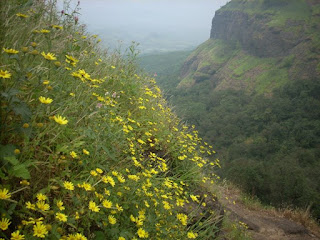
The Foreground shot


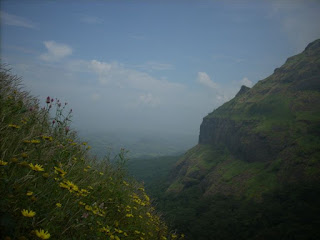
The Background shot

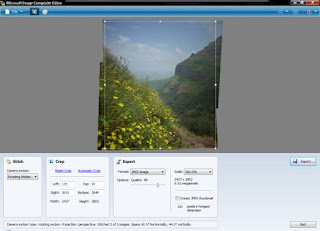
Once home, I open these two images in a freeware Microsoft ICE (Yes, you are reading Freeware and Microsoft in the same line!). ICE stands for Image Compose Editor. Simply opening the images in ICE is enough. They get stitched by default. ICE has three menus: Stitch, Crop and Export. Various kinds of camera motions are considered by the software when the images are opened. It chooses the one it finds the best. Sometimes, if I wish to change the perspective, I feed in Rotating Motion. This lets me change the Projection (distortion and the perspective). Once the images get stitched, I rarely have to crop the images as they were fore planned. Then I do post processing in the form of enhancing the levels, curves, colour balance, hue and saturation. If there are any blown out highlights, I increase the levels of Black of the White colour in the Selective Colouring. Sometimes, I use the gradient tool to get the graduated neutral density filter effect.

Both images opened in Microsoft ICE.

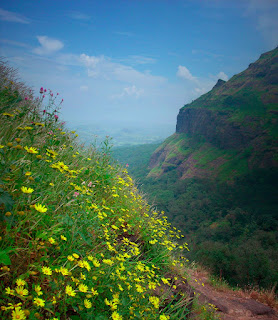
Final Image after post processing
A few more Vertoramas:


Torna


Torna again
Sometimes, we can go the other way round. Take horizontal panoramas keeping the camera vertical. This again gives a massive resolution to the image and also gives it more height.

An example of a panorama taken from multiple images in horizontal orientation
To give justice to vertoramas, you need to print them really big. Atleast 18"x18" (or whatever the aspect ratio is) + border + frame and put it high on display. The reason is there is tremndous amount of data captured in the image and it will simply go unnoticed. Don't worry about printing at 300dpi. I've printed a few at 150dpi and they look pretty cool. One of the most appreciated photo at my father's office is a 8x12" frame of Naukuchiatal taken by a 2 MP cellphone. Resolution, sharpness the matter the most only on internet forums. For a landscape its the light, the colours and the composition which matters period. You might notice that my images are a little extra saturated. The reason is the prints I have made till now have lacked saturation. Hence I increase it in the image so that the prints do fine.
My landscape photography is evolving rapidly. I shall further experiment with many other techniques to get the images I want. For now atleast, Vertorama provides me a great hand to capture the Sahyadri.

Saturday, October 10, 2009

Side Effects of Photography and the rehabilitation process

NOTE: The side effects I'll be highlighting are exclusive of the miniscule bank balance that photographers usually have.
I started photography in May 2007, when I received my 1st camera: Sony Ericsson W810i Camera phone featuring a solid 2 MP camera. Before that, I used to lot of extra-curricular activities like trekking, going outdoors for camps, trails; reading fantasies, fiction etc; playing mandolin, listening/searching for new genres of music; playing volleyball, watching good movies, spending time with my friends and spending special time with special friends. And of course, the day before the exams used to be spent studying. SLowly slowly, things started changing as I got more hooked on to photography. It began with liking the photos, then searching for better cameras, finding shops, finding better shops, reading reviews, reading about the photographers, watching photographs, learning photoshops, participating in the forums, asking queries, answering queries, teaching photography to a few, getting paid :) and lastly taking photos, segregating them, editing the good ones, posting them on the web, receiving C n C. And finally writing about the entire experience. I'm not talking about the blog alone. I'm on my 7th notebook (dedicated to photography) at present!
Well, since a few days, I've become increasingly conscious that I am spending way too much time on photography than what is needed to create good looking pictures. This realization is especially bitter coz at present I don't own a camera!!! I use a friend's Olympus 570uz and a superb Nikon L10 (donated by a friend). All of a sudden I realized what I was missing..Since then, I've been trying to make up for the loss. I've decided to trek the Sahyadri in such a way that would give maximum output. So I've started trekking with a few friends. Visited Kaas Plateau, Purander, Torna aand Harishchandragad. I try to document as much of the nature as I can. I've gotten hold of really handy instruments like GPS, water quality test kit, clinometer campass to document the geology and hydrogeology of the area (I'm not that good at this, but kaam ho jata hai). Then I try to observe and document the odonates and the butterflies, birds, wildflowers, the trees and also the socio-economic and cultural scence. This way, I make maximum use of time, place and myself! I hope someday I can put these treks together into a series of papers or something of that sort.
As I decided to review my old hobbies, I started by reading Congo and and later on, His Dark Material trilogy. Both are fantastic. While Congo is full of suspense, I have to admit that it didn't surprise me. I kind of expected shocks at every page, if not at every line. After all, it is a Michael Chrichton book. It does shock you ( It has to!). But what sets him apart from others is the way he reason things, people, situations and of course the concepts. A true genius. I plan to write exclusively about him some other time, so this will do for now. The other one I read, His Dark Materials, is a trilogy consisting of Northern Lights, The Subtle Knife and The Amber Spyglass. Again, a work of a genius. I would have ridiculed even God if he had said I would like a fantasy tale more than LOTR. But well, His Dark Materials, I find, is better (This is debatable, UMMV-Ur milage mey vary). It is fast, interesting and keeps you focussed. THe best part I liked about the trilogy is, again, the way it has been written. Pullman is a master at describing feelings. Especially of the little ones (Harry Potter, suddenly, seems so grown up! even in the 1st book!!). You feel so much involved with the characters. YOu actually start believing in them. Though it is a fantasy and has plenty of adventures, it has a love story which I loved the most. You will cry buckets before you keep this book back to the shelf. This is possible only if that child inside you is still alive. Else you'll find this, like everything else around you, childish. Oh one more thing: These books (HDM) are out and out against christanity. THe God is a villain here. Strangly, it is said the story was inspired by Milton's Paradise Lost. The Title has been taken from the same.
Now, there is apile of books to be read on my desk. On top lies The Hitchhiker's Guide to the galaxy. I've seen and like the movie. The book, however, can wait. I've dug out the Man Eaters of Kumaon. I don't remember how many times I've read it. Every time is a new experience. Just finished reading the story of Robin, Corbett's dog. I shall write more about the book later on.
One weekend was spent on Tarantino movies. Reservior dogs, Pulp Fiction and Kill Bill 1 and 2. Of course I had seen them before. But to get the feel (and to pass the time), I decided to watch them at a stretch. I'll write more about movies later.
I've decided to take music seriously. Till now, I've been trying hard to learn mandolin on my own. I play considerably well too. But I struggle with just too many things. finding rhythem, tuning (GDAE for western and p'sa'p'sa' for Indian..How I wish to play all genres with GDAE!), notes (its all guesswork here!), left hand technique (This is the left handed equivalent of the Right hand technique), tremolo, crosspicking, trying to listen to Bluegrass (even dreaming of playing it is difficult!) etc etc etc.. Now I've decided to stop this Eklayvagiri. A friend just gave me a contact of some mandolin teacher. Hopefully, he'll guide me from here on..
Apart from all these activities, I increased my social attendance. I'v met interesting people. Rightly guessed the sun signs of a few (they always get freaked out, don't they?). Such solutions, by default came with less time being spent on photography. In fact there were days when I didn't even think of camera!
Bottomline: While trying to get out of an addiction, don't give a damn to that addiction. Instead, give more importance/prominance to the alternatives. They, surely are equally interesting. And addictive.

Wednesday, December 17, 2008

Field experience- Canon 450D and 55-250/5.6 IS

First of all, this is NOT a review of any sort, not even a field test. I am merely sharing my experience with the Canon system in general and 450D and 55-250 IS lens in particular.
Dawn over Kaziranga


Recently, I had an opportunity to try out the kit at Kaziranga National Park, Assam. Though we stayed in the park for only two days and were 'inside' the park for only 3-4 hours, We saw a great deal of wildlife.
One-horned Rhino, Kaziranga National Park


The 450D felt very comfortable in my hands. It felt lot lighter than my Pentax K10D and I liked this fact. Its viewfinder was somewhat darker than K10D, but I didn't have much issue in focusing manually. Its LCD was bigger than K10D but was little confusing. Image looked very dark in the LCD than on monitor. I never used the Live view mode. The very fact that I have to go through settings to change from LV to VF mode didn't impress me at all..(please let me know if there are any shortcuts to do so)..

I liked the dedicated ISO button in the 450D. It enabled rapid change of ISOs as and when I needed and I needed to change ISO very frequently. Auto focus operation was super quiet. almost SILENT. Focus was fairly quick too. The fact that it was so silent also made it appear even more quick. Coming from manual-focus-lenses background, this was the first AF tele (provided you call 250mm a tele. On APS-C, it certainly is.) I ever used and I was in awe of the AF to say the least. Initially, I had difficulty in shooting birds in flight with the combo but soon learnt the beauty of Al-servo and the central cross-hair AF point. I could effortlessly track every bird I was able to get inside the frame. Once again, I was limited by my own self. IQ wise, 450D was excellent. I used it most of the times at ISO 800 and at times at ISO 1600. Seriously, there are many things which we hear on forums and reviews which are to be simply forgotten during actual field work. High ISO is one of them. How am I to avoid ISO 1600 if the camera meter shows 2" even at ISO 1600, wide open? Many times I had to use EV to increase shutter speed by increasing ISO even further. Here I wished Canon had 5 stops of EV instead of 2. Especially considering the over- exposure Canon bodies normally cause. This brings us to the only serious issue I had with Canon system- the one which cost me at least half a dozen of well taken images- WASHED HIGHLIGHTS. I had heard from most of the Canon users that Canon bodies over expose slightly and hence, one should keep the EV at -2/3. I invariably had to keep it from -2/3 to -2! Being a user of Pentax, which is (in)famous for underexposed images, I was never bothered by washed highlights before this and I didn't even know it until I saw the images on monitor. Damn. I had to shoot jepg because there weren't many memory cards provided with the camera and we hadn't taken laptops for security reasons. The images had appeared darker in the LCD which refrained me from using extreme negative EV. I think shooting RAW would have solved the problem. Thus, this in no way count against the camera as I should have, following John Shaw's guidelines, calibrated the meter before use or at least shot in RAW.. I didn't fiddle with the camera much and used it only in the field. Hence, I'm sure there are many more tit-bits which I don't know of.

Tusker, Kaziranga: Plenty of washed highlights in this image, toned downed a bit.


Overall, I liked the camera but is it worth 38k? certainly not. I won't give more than 20k for it or any camera in this class, especially when one can get a 40D for 39k. I used the 450D exclusively with the 55-250IS lens even though I was provided with the 18-55IS lens. 55mm is wide enough for most of the landscape shots I usually take on field. However, I think ideal focal length for the job would have been an image stabilized 28-300/5.6 or a 35-350/5.6..I would have preferred the latter. Canon did make these lenses, but they were too expensive and heavy for the target users and purpose they fulfilled. All shots of birds were taken at 250mm. Mammals required the lower focal lengths. IS was God sent. It gave me sharp images at 5.25 stops more than the normal shutter speed when I shot at the wider end of the lens. At tele end, I could get about 2.5- 3 stops advantage. IS clearly substituted tripod at least for this tour. Of course there were opportunities which only tripod could have taken, but they weren't many. I am planning to buy this lens and a used 400D.
People asked if 250mm is enough? Well, I performed a simple exercise- I used Juza's focal length calculator with references being 250mm on a 10 MP Canon APS-C slr and a 720 X 480 canvas. With the help of this calculator I found out that if I crop a 10 MP image to 7 MP, I will get a field of view (FOV) of a 300mm lens. Similarly, I will get FOV of 400mm, 500mm and 600mm lenses if I crop the image to 4 MP, 2.5 MP and 1.7 MP. I know 1.7 MP sounds too small. But I mave made excellent 12 X 8 prints of images as small as 1.26 MP. My only concern is of IQ. Yes, IQ isn't the best at f5.6 but improves dramatically through f8 and finally at f11. In Pune, the weather is mostly sunny and I am able to usually shoot at f11-16. Its weight is perfect for my needs- a light weight, in-expensive lens which would remain with me 24/7. Add the close focusing ability so essential for dragonfly, butterfly and reptile shots and you have the truely wonderful all round lens required for wildlife documentation. Seriously, 55-250 IS lens is one of the best ways one can spend 13.5k. :)
The 400D decision is based on the fact that I liked the 450D. Yes, they are two different cameras but belong to same class. Quite similar Viewfinder, ISO performance, fps, negligible weight difference etc. I never used the Live view and the bigger LCD didn't quite impress me. The minor differences are not field relevant. The only major difference IMHO is 2 extra MPs, which are enough to make a difference between the FOV of a 400mm lens and a 450mm lens (on 35mm film). That, however, isn't worth the extra cash. The 400D and 55-250 make an inexpensive kit which I can carry around all the time without stress of lugging $$$$ everywhere I go. The money saved by opting for such an inexpensive kit will go for a decent laptop which will replace my 11 year old desktop or may be as saving for 100-400 or a 400/5.6 in near future.
Few images from the combo..


A few images from the trip:

Wild boar, Kaziranga

Rhino, Kaziranga


Hog Deer, Kaziranga


Safari

Sunset, Kaziranga


Moonrise over Kaziranga


Monday, September 29, 2008

Mayureshwar Wildlife Sanctuary- August 2008


Department of Environmental Sciences, University of Pune was conducting a day long workshop on various environmental issues faced by the local communities over there, introducing them to the concept of sustainable development and helping in resoliving the man-wildlife conflict at the border villages around the Sanctuary..We arranged the workshop at a village school, very near to the Sanctuary limits and just near this Water Tank..


As usual students arranged the whole event, girls working the most..I am more or less useless when it comes to these things, hence spent time and puting myself to some use..yes, PHOTOGRAPHY!


I had taken the following gear-
1. Pentax K10D.
2. Pentax FA50/1.4- For low light and portrait photography..
3. 18-55/3.5-5.6- kit lens which came along with the K10D..
4. Super Macro Takumar 50/4- For macro stuff. No I hadn't bought it, just 'testing' it on field..
5. Pentax SMC 300/4- For birds/mamals..
6. Vivitar 2X TC
7. Juhi's Tripod (Yuntgen or something)- I didn't even opened it..
I had stuffed the gear along with clothes etc in my main bagpack (owned by Darshan)..I still don't have a dedicated bag for photgraphy equipment..


Forest officer Mr. Nale was a very dynamic person. He encouraged me a lot and told us of his many wild experiences..It was sad that other students were least interested..Here was a man of much higher calibre telling us something which is so rare these days- first hand experiences- and they wre busy playing Antakshari..


Next day at dawn Nale Sir took me in his car and we went for a quick trail..Mayureshwar Wildlife SAnctuary is well known for its Chinkara population..These Antelopes are well dispersed in the Sanctuary and off it too..Nale Sir knew of a loner male who, after being dismissed from his herd by a younger and stronger male, liked to stay around a particular intersection of roads..I was able to get a decent image of him, even though I nearly missed the shot thanks to the cumbersome manual focus of the 300/4..We saw few herds, I saw a jackel running away from us..The Chinkaras weren't bothered much by cars than they were by pedestrians


 During off times, I used to hook on the Macro lens..There were always some or the other bug around..


Overall, it was a great learning experience.. learnt lot of lessons..


Tortoise beetle


Thursday, July 3, 2008

Super Macro Takumar 50/4 III


I have been doing better and better with the Super Takumar 50/4 Macro with each passing day. Though I don't get to spend much time with it just few minutes a day, I do get at least 2-3 usable images every time I take out the camera. The lens has replaced my Kit lens and is always mounted on the K10D.


Though we ain't sure about the above species, Juhi thinks it is a Blue Tiger.


This is Common Red Eye (Matapa aria) of Hesperiidae family as identified by Juhi. Hesperiidae members are also called skippers for their quick darting habits (wikipedia). There are about 3500 species of them worldwide belonging to 550 genera.


I had never thought a ground skimmer (Diplocodes trivialis) could make me skip a heart beat. But as I looked throught the Pentaprism of the K10D and focused the silky smooth ring of the Super Takumar, I was completely zapped by its beauty. For a moment I couldn't help but stare at it without pressing the shutter. Ground skimmers belong to family Libellulidae which include 1139 species worldwide. For more information on Odonates of peninsular India, lo on to this link http://www.ias.ac.in/initiat/sci_ed/lifescape/odonates.html.


I don't know whether it is the lens, the weather which yielded this magic. None of the 6 people who were there with me cared to notice this beautiful standout. How can soo many people simply don't care to appreciate nature?


This is a Crimson Marsh Hawk male. (Trithemis aurora). This is the first Dragonfly I was able to capture using the SUper Takumar. I was disappointed as almost 2 weeks went past without a single good image of an odonate with the lens. Well the wait yielded warm returns.


When I spotted this plant in Alice Garden, I remembered a quote from a Canon user on an Internet forum. He had said that he would love to buy K10D only to shoot Reds!! I wondered whether K10D was really so fabulous with Red. Yes, it certainly is!


Insects are actually like small kids. Very shy! While kids hide behind their parents, curtains, this one decided to hide under the Golden Duranta leaf. But inquisitive as it was, it couldn't help but keep an eye on me!


I had to actually lay in wet dung to get this image. I have found the perfect photography wear in my rain pants and jacket. I can go anywhere without getting my clothes dirty and this makes my Mom unusually happy(more than my photos make her!).


This leaf isn't eaten to this shape. Clearly God favoured this shape. As the lens is useless for non macro subjects like this big leaf, I got underexposed shot but thanks to RAW and the S/W Raw Therapee that I could adjust the exposure.


I have been obsessed by the colour rendition given by the Super Takumar 50/4 Macro. Its absolutely mind blowing. The adjoining image is not even cropped, only resized and copyrighted. I wouldn't even had considered it worth photographing few weeks ago. Every moment I'm growing up as a photographer and understanding the magic of an SLR.


It is not a Tennis ball..It is a nest of a very small spider which looks alarmingly similar to the Giant Wood Spider. You can actually see the eggs inside. Nephila family members are well known amongst spider lovers for their skillfully constructed beautiful webs.


This spider belongs to genus Telamonia from the Salticidae family a.k.a 'Jumping spider family' was identified by my spiderman friend Sudhikumar A V. There are 5000 species belonging to 500 generas in the family Salticidae which is the largest spider family.


This spider was good enough to give me another chance to capture it. It came out of the Duranta leaf and posed for a brief moment to again disappear behind it.


This image has been spoilt by the harsh light of the onboard flash. I do need a better flash or a better flash position. None-the-less, I could have diffused the light with a butter paper. But your brain doesn't always work at the right time..